Ten million dollars of billboards, paid for in equity
An out-of-home media company invested roughly $10M of billboard inventory into Tamam in exchange for shares. No cash moved. Here is how the deal worked, what we put on the roads, and what it did to the company.
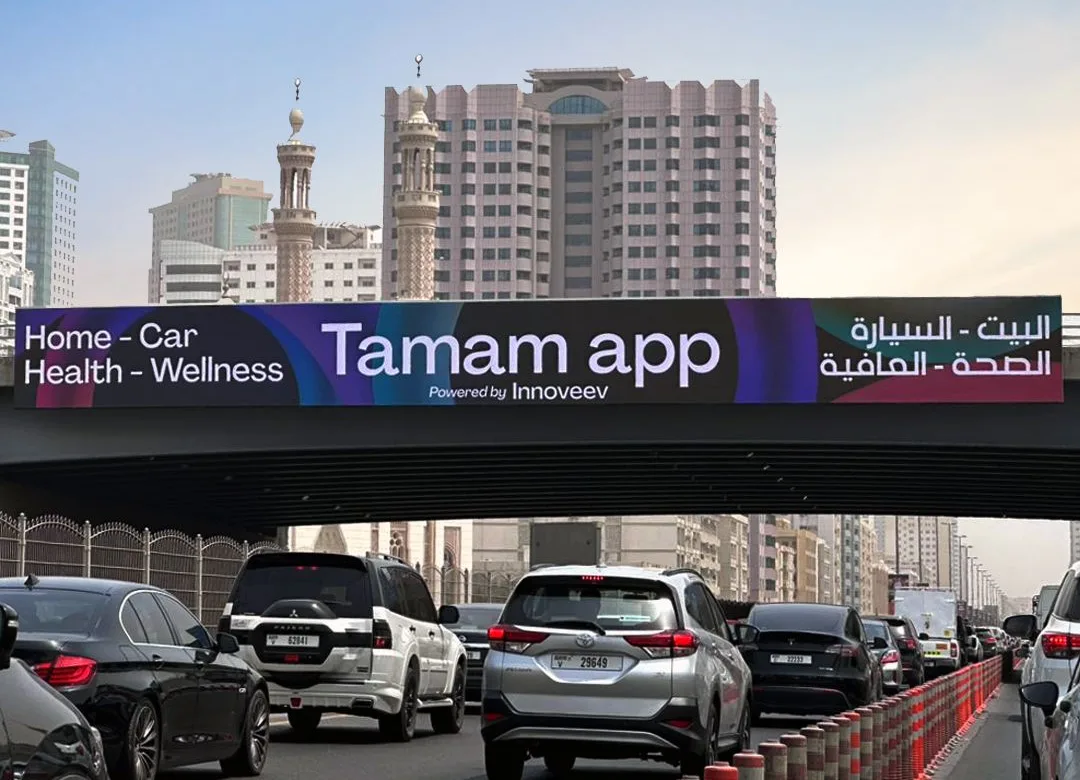
There is a strange moment that comes with seeing your own app on the side of a road. You have stared at those screens for years at the size of a business card. Then one morning you are stuck in traffic in Sharjah and the same interface is stretched across a bridge above six lanes, and a few thousand people are reading it without any idea that you had anything to do with it.
That is roughly how the last stretch of Tamam's growth has felt. We want to write down how it happened, because the mechanism we used is not one people in this region talk about very openly, and we think more founders should know it is available to them.
What Tamam is, briefly
Tamam is an on-demand services app for the United Arab Emirates. Twenty-nine services across four categories: home, car, health and lifestyle. Cleaning, air conditioning repair, plumbing, painting, pest control, oil changes, battery replacement, roadside assistance, nursing visits, lab tests, physiotherapy, salon appointments, pet grooming, laundry.
You open the app, pick what you need, and see an honest price range in dirhams before you commit rather than after. A vetted professional turns up, and the final price stays inside the range you were shown. If you would rather not deal with an app at all, you can book exactly the same thing over WhatsApp, which a surprising number of our customers prefer.
It covers 686 areas across all seven emirates. The software was built by Innoveev, who were the founding engineering team on the product and still run it today. That relationship matters later in this story, because a national advertising campaign is only ever as good as the system sitting underneath it.
A finished product and no way to tell anyone
By the time we were ready to go wide, we had the part that is genuinely difficult. The app worked. The supply side worked. Coverage across the seven emirates was real rather than aspirational, which is a distinction a lot of marketplaces gloss over.
What we did not have was a marketing budget of the size this country demands. The UAE is a market where attention is expensive and where physical presence still carries enormous weight. Every serious consumer brand here is on the roads. If you are not, you read as small, no matter how good your product is.
We could have put whatever cash we had into performance marketing instead. The trouble with performance marketing for a services marketplace is that it buys you transactions but it does not buy you belief. Someone letting a stranger into their home to fix their air conditioning, or into their life to take a blood sample, is making a trust decision, not a price decision. Trust is very hard to buy one click at a time.
What media for equity actually means
The idea is simpler than it sounds. A media owner has advertising space. That space has a price. Instead of you paying that price in cash, the media owner hands you the space and takes shares in your company to the same value. They become a shareholder. You get the campaign.
It is a common structure in Europe and the United States, where a number of well known consumer companies were built on it, but it is still unusual in this region. Most founders here assume media is something you buy, in cash, at the point of use. It is worth knowing that it is also something you can raise.
The important thing to understand is that this is a real investment, not a discount. The media owner is taking equity risk. If the company fails, their inventory is gone and their shares are worth nothing. They are betting, in exactly the way a cash investor bets, and they should be treated with the same seriousness.
Why a media owner would take shares instead of a cheque
Two reasons in our case, and we would not pretend either of them is a clever trick.
The first is that they believed in the category. On-demand home and car services is not speculative in this market. People here already outsource this work. The question was never whether the demand exists, only who would organise it well. Our partner could see the size of that prize as clearly as we could, and taking equity was a way to own a piece of it rather than simply invoice against it.
The second is relationships and trust, which is the part that does not generalise neatly into advice. Deals like this get done between people who already know each other and have a reason to believe what the other one says. There is no structure that substitutes for that. If you are hoping to do something similar, the relationship is the prerequisite, not the paperwork.
How you put a price on a billboard
This is the question every sharp reader asks next, so let us answer it plainly rather than let it hang.
The roughly ten million dollar figure is the published rate-card value of the inventory. Rate card is the media owner's official list price for that volume of space over that period. It is the number on the price list, and like most list prices in most industries, it is the top of the range rather than the middle of it.
We are stating the basis openly because it is the honest thing to do and because anyone who works in media will assume it anyway. What we received was ten million dollars of space as that space is formally priced. Whether every slot would have sold at that price to a cash buyer is a different question, and not one we can answer for someone else's business.
What went up
The campaign was deliberately built to hit people in more than one context, because a single format reaches the same person in the same mood over and over.
- Large-format roadside boards, the unipoles and megacoms along the major arteries, which do the heavy lifting on reach.
- Digital screens, which let us rotate creative and weight certain messages to certain times of day.
- Bridge banners and gantries spanning the roads, which commuters pass twice a day, every working day.
- Transit and street furniture, closer to eye level, where people are on foot with a phone already in their hand.
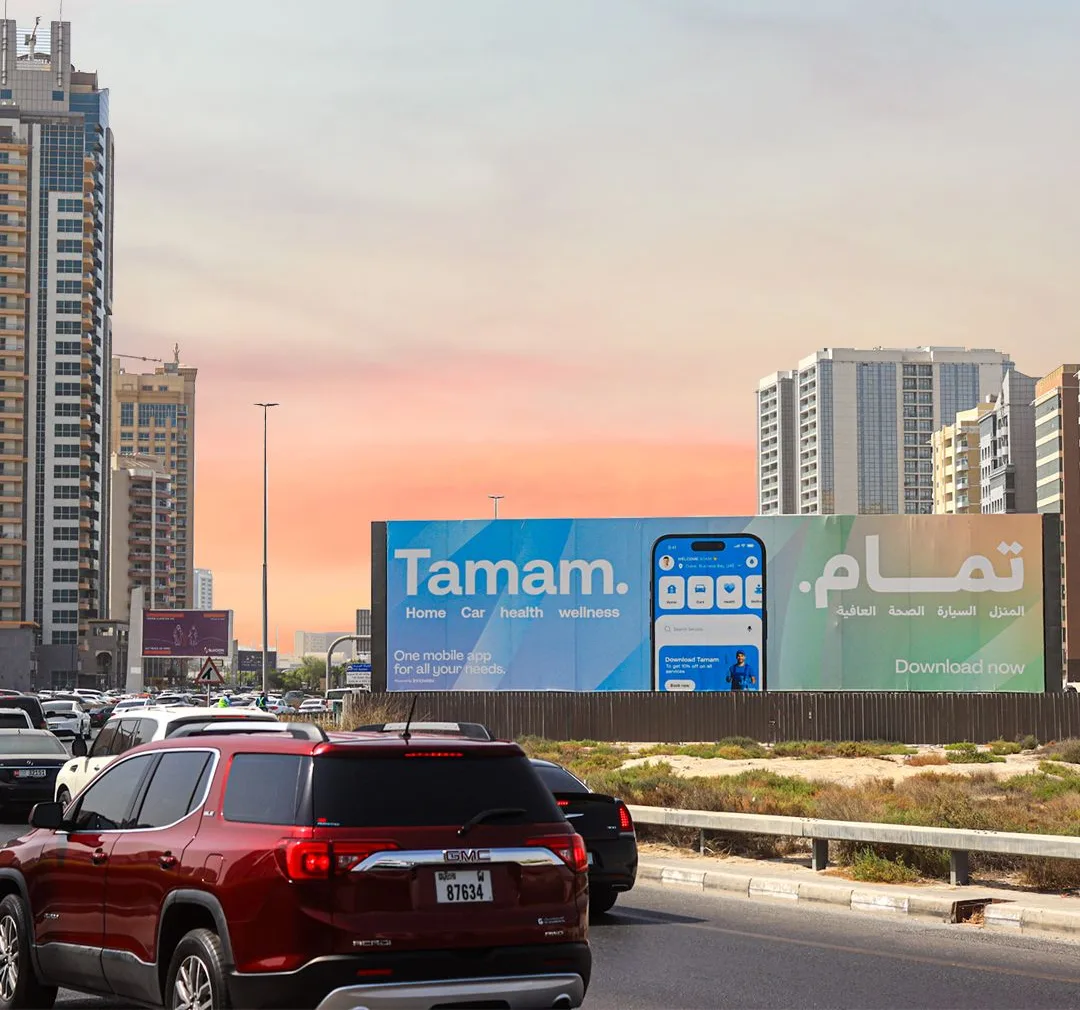
Running English and Arabic together on the same board was not a compromise, it was the point. This is a country where the person in the next lane may read one, the other, or both, and a campaign that picks a side loses half the road.
Writing for someone doing a hundred kilometres an hour
This is where we got the most humbling feedback, and it came from the road rather than from anyone in a meeting.
Our early creative was, in hindsight, absurd. We had spent years describing Tamam to investors and to each other, and all of that description leaked onto the artwork. Category lists. Qualifiers. A sentence explaining the pricing model. It read beautifully on a laptop, at rest, at arm's length.
A driver has perhaps two seconds, at speed, at an angle, while doing something more important than reading your advertisement. Anything beyond a name, a category and an instruction is decoration. We cut it back hard, and then cut it again, and the version that finally went up says very little: what it is for, what it is called, and what to do next.
If we were starting again we would design the smallest version first and only add detail if the format genuinely allowed it, rather than designing a full message and trimming it under protest.
What going national does to the software
This is the part that is easiest to underestimate, and it was raised on the engineering side before the first board went up.
Outdoor advertising does not behave like digital. Digital demand arrives as a manageable stream you can throttle by adjusting spend. Outdoor demand arrives in bursts, tied to when people are actually on the roads, and you cannot turn a billboard off because your servers are struggling. The boards go live and the traffic is simply there.
So the platform had to be ready for spikes rather than for averages. Beyond capacity, the booking path itself had to get shorter. Someone who has just read a board has a few seconds of intent, and every extra step spends it. That work went into both routes into the product, the app flow that gets a booking done in under a minute and the WhatsApp path for people who would rather just send a message.
The least glamorous piece was coverage. Advertising nationally is a promise, and a promise you cannot keep is worse than silence. Getting real professional coverage across all seven emirates, so that the 686 areas on the boards were areas we could actually serve, was the unglamorous prerequisite for the whole campaign. The boards themselves carry a small line reading powered by Innoveev, which is a fair description of what was holding the thing up.
Measuring the thing nobody clicks
Out-of-home has an old reputation for being unmeasurable. That is less true than it used to be, but it does require you to measure deliberately rather than expecting a dashboard to do it for you. We used four approaches at once, on the principle that no single one of them is trustworthy alone.
- Distinct contact points per placement. Different boards carried different numbers and codes, so inbound bookings identified their own source without the customer having to do anything unusual.
- Scannable codes on the creative. These earn their place on transit and street furniture, where someone is standing still. On a highway board at speed they are close to decorative, and it is worth being honest about that.
- Geographic lift against control areas. Comparing activity in areas with boards against comparable areas without them is the closest thing to a controlled experiment available here, and it is the method we trusted most.
- Asking people directly at signup. Self-reported answers are noisy and everybody knows it, but they are a useful sanity check when the other three disagree.
What actually changed
We are not going to publish performance figures here, so take the following as description rather than proof.
The clearest change was recognition. Tamam stopped being a name that needed explaining. That sounds soft, and it is not. When people have seen your name above a road on their commute, every conversation you have starts several steps further along, and a young company stops looking like a young company.
The second change was on the supply and partner side. Conversations with service professionals, suppliers and commercial partners became markedly easier. Visible presence reads as permanence, and people are more willing to build a business on top of something that looks like it will still be there next year.
The third was with investors. A visible national campaign is evidence of a kind that is difficult to fake, and it changed the tenor of those conversations in a way a deck could not.
If you are thinking about doing something similar
A few things we would tell someone in the position we were in.
- Have the product finished first. This structure funds distribution, not development. A media owner is far more willing to take equity in something that visibly works than in something that is still being built.
- Agree the valuation basis before the headline number. Rate card and net value are different figures and the difference is real money in shares.
- Fix your fulfilment map before you buy the reach. Advertising you cannot service is a liability, not an asset.
- Design the creative for two seconds. Whatever you think the minimum is, it is less than that.
- Set up measurement before the first board goes up, not after. Retrofitting attribution onto a campaign already running means guessing.
- Remember you are taking on a shareholder, not a supplier. Their incentives, reporting and expectations are those of an investor, and the relationship lasts long after the campaign comes down.
Media for equity is not free advertising. It is advertising you pay for in the most expensive currency a growing company has, which is ownership. For us, at the point we were at, with a product that worked and no way to tell anyone about it, that was the right trade. It will not be the right trade for everyone, and anyone who tells you otherwise is selling something.